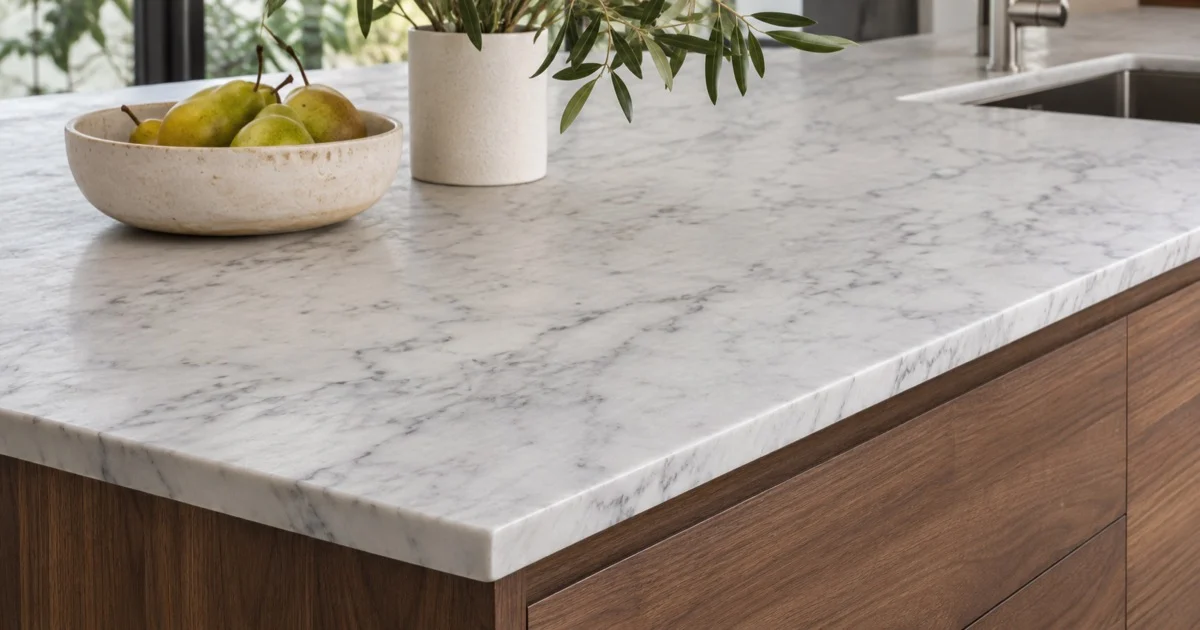
What is marble? Marble is a natural stone formed when heat and pressure transform limestone or dolostone. Its colour and pattern vary from slab to slab. For benchtops, it suits people who value natural variation and accept careful cleaning, possible etching and changes in the surface through use.
At ESG, start with Ceppo Rosso, then compare Calacatta White and Bianca Perla. The right choice depends on how you want your kitchen to look and how you use it.
Which marble slabs should you compare?
Compare Ceppo Rosso’s reddish fragment pattern with the white background and grey veining of Calacatta White, or Bianca Perla’s beige-grey tones and subtle veining. View each slab beside your cabinetry and flooring samples.
 Main selection
Ceppo Rosso
Reddish fragment pattern
View slab Compare
Calacatta White
White background, grey veining
View slab Compare
Bianca Perla
Subtle veining, polished finish
View slabCeppo Rosso’s brecciated appearance, meaning a pattern of broken-looking fragments, makes joins worth reviewing on a proposed layout. ESG lists it in its marble slab collection; confirm the selected slab’s composition and suitability before specifying it.
Bring your plans to ESG’s Narre Warren showroom if you would like help comparing these three options. Look at the full slabs rather than choosing from a small sample alone.
What is marble like as a benchtop?
Marble offers individual patterns and different finishes, but it needs protection from acids, scratches and impact. Etching is a chemical reaction that changes the surface finish; staining happens when a substance penetrates the stone and leaves discolouration.
| Material | Food-acid resistance | Care attention |
|---|---|---|
| Marble | Low | Higher |
| Genuine quartzite | Generally high | Moderate |
| Granite | Generally high | Moderate |
All natural stone needs appropriate care. If a dull mark from lemon juice would frustrate you, compare other suitable materials before committing.
How should you finish and care for marble?
Choose your finish from representative samples, then use gentle cleaning and everyday protection. Honed means a smooth, low-sheen surface; polished means a more reflective finish.
- Blot spills promptly, especially acidic foods and drinks.
- Use a soft cloth and a suitable neutral stone cleaner.
- Use chopping boards, coasters and trivets.
- Avoid vinegar, citrus cleaners and abrasive pads.
An impregnating sealer reduces liquid absorption, but it does not prevent acid etching. Follow the Natural Stone Institute’s care guidance and confirm instructions for your exact stone and treatment.
What should you confirm before ordering?
Confirm the actual slab, finish, final site measurements, joins, edges and installation access before approving fabrication. Slab dimensions vary, so confirm them against your selected slab and on measure.
Natural marble remains an option after Australia’s ban on engineered stone benchtops, panels and slabs from 1 July 2024. See Safe Work Australia’s ban guidance for its scope.
Never cut, grind, sand or drill stone yourself. Processing can release respirable crystalline silica, dust small enough to enter deep into your lungs and cause serious disease, including silicosis.
When you ask “what is marble?”, weigh its care needs alongside its appearance. Compare Ceppo Rosso, Calacatta White and Bianca Perla in person before deciding.
What else should you know about marble?
What is marble made of?
Geological marble consists mainly of carbonate minerals, commonly calcite or dolomite, formed when heat and pressure transform an earlier rock. Other minerals can affect its appearance. Commercial names and catalogue categories do not always establish geological composition, so confirm the classification and care requirements of your selected slab.
Does sealing prevent marble from etching?
No, an impregnating sealer can reduce liquid absorption and improve stain resistance, but it does not prevent acids from reacting with marble. Etching changes the surface finish and may appear as a dull patch. Ask a stone professional to assess any mark before trying to remove it.
What is marble like in a busy kitchen?
Marble can suit a busy kitchen if you accept its care requirements and possible surface changes. Protect it with chopping boards and trivets, clean gently and remove spills promptly. If visible etching would bother you, compare suitable quartzite or granite slabs before committing to a selection.
Can you cut or drill a stone benchtop yourself?
Never cut, grind, sand, drill or otherwise machine a stone benchtop yourself, including for a small tap hole or edge adjustment. Processing stone can release hazardous respirable crystalline silica. Have a professional fabricator assess and carry out modifications using appropriate controls, and leave slab handling and installation to professionals.