Stone care & maintenance guide
Care starts with knowing your surface. Use a cleaner approved for the material and finish, wipe spills promptly and follow the supplier’s instructions. Natural stone may need a suitable sealer, while existing engineered stone needs its own manufacturer’s care routine. Choose your surface below, then find products and buying options.
How do you care for natural stone?
Use a gentle, non-acidic cleaner suited to your stone, its finish and any sealer.
- Blot spills promptly. Wipe with a soft cloth, rinse cleaning residue and dry the surface.
- Keep vinegar, lemon-based cleaners and abrasive scouring products away from sensitive stone.
- Use coasters, chopping boards and trivets to protect working surfaces.
- Ask whether your stone needs sealing. Sealing improves stain resistance; it does not make stone stain-proof or stop marble etching.
How do you care for existing engineered stone?
Follow the original manufacturer’s care guide for your specific surface and finish.
- For Caesarstone quartz, its care guide recommends a clean damp cloth with warm water and mild detergent, or its Spray Cleaner.
- Use the cleaner and method approved for your brand. Avoid prolonged rubbing in one spot.
- Caesarstone quartz does not need polishing or sealing. Do not apply that advice to every material sold under a surface brand.
- For damage or alterations, contact a qualified professional. Never cut, grind, drill or mechanically polish the surface yourself.
Existing engineered stone and Australia’s ban. The ban on manufacturing, supplying, processing and installing engineered stone benchtops, panels and slabs began on 1 July 2024, with limited exceptions. This page covers care of existing installations. Processing stone can release hazardous silica dust. Do not cut, grind, drill or mechanically polish any stone yourself. Arrange any repair, modification or removal through a qualified tradesperson. Read Safe Work Australia’s guidance.
Which stone care products should you consider?
Start with these options for routine cleaning. Match the product to your exact surface, follow the label and test as directed. A cleaner’s suitability matters more than its brand name.
NATURAL STONE & QUARTZ COMPOSITE
Lithofin MN Easy-Clean
A ready-to-use, mildly alkaline cleaner for small stone surfaces such as kitchen benchtops and vanities. Lithofin’s Australian technical sheet includes natural stone and quartz composite in its scope.
Confirm compatibility with the surface manufacturer. Do not spray onto hot surfaces.
Visit Lithofin’s official website →
NATURAL STONE & TILE
Aqua Mix Concentrated Stone & Tile Cleaner
A pH-neutral concentrate for routine cleaning. The manufacturer lists polished and unpolished natural stone, including marble, granite, limestone and travertine, on sealed and unsealed surfaces.
Dilute according to the label. Check suitability for any surface not specifically listed.
View manufacturer guidance →
COMPATIBLE CAESARSTONE SURFACES
Caesarstone Spray Cleaner
An option in Caesarstone’s own everyday care routine. Use the guidance that matches your Caesarstone product and finish, including its quartz care guide for an existing quartz installation.
Do not assume it is approved for marble or another manufacturer’s surface.
View manufacturer guidance →Stone cleaners available through hardware retailers
Glitz and Hillmark offer stone-specific cleaners listed by major hardware retailers. Check the exact bottle and finish restrictions. For existing engineered stone, confirm approval with your surface manufacturer before using a third-party cleaner.
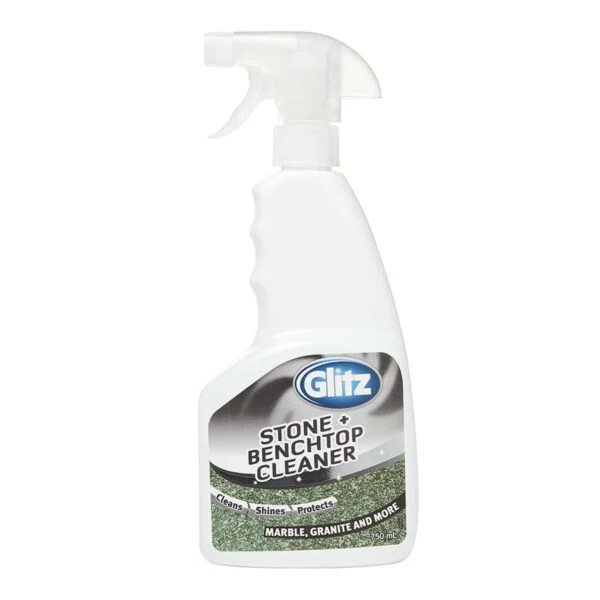
MARBLE, GRANITE & RECONSTITUTED STONE
Glitz Stone & Benchtop Cleaner
Pascoes describes this as a non-acidic, non-abrasive cleaner formulated for marble, granite and reconstituted stone. Check its suitability for your particular finish and any existing sealer before use.
Read Glitz manufacturer information →
View Glitz at Bunnings →
POLISHED STONE BENCHTOPS & VANITIES
Hillmark Stone Kleen & Protect
A pH-neutral cleaner for polished marble, granite and reconstituted stone surfaces. It contains silicone polishing agents, so confirm that a polish layer suits your surface.
Not for porous, unpolished stone such as limestone or sandstone, or floors and other surfaces where slipperiness may be hazardous.
Read Hillmark’s surface restrictions →Where can you buy stone care products?
Compare major hardware retailers with the manufacturers’ own websites. Product ranges and stock vary by store and delivery suburb. Check the exact cleaner, label and surface compatibility before ordering.
Bunnings Warehouse
Lists Glitz Stone & Benchtop Cleaner and Hillmark Stone Kleen & Protect. Select your local store or delivery suburb to check availability.
View Glitz at Bunnings →View Hillmark at Bunnings →Mitre 10
Lists Hillmark Stone Kleen & Protect under “Cleaner Stone Benchtop 375ml”. Confirm local availability and the product’s polished-surface restrictions.
View Hillmark at Mitre 10 →
Home Hardware
Lists the Hillmark stone benchtop cleaner online. Not all stores carry it, so check with your local store or enter your delivery suburb before ordering.
View Hillmark at Home Hardware →Lithofin official website
Start with Lithofin’s Australian website for product advice, technical information and its reseller finder. Use it to find an appropriate product and local buying option.
Visit Lithofin’s official website →Find a Lithofin reseller →Aqua Mix Australia online store
Lists Concentrated Stone & Tile Cleaner. Review the product information and application instructions before choosing it.
Shop Aqua Mix cleaner →Caesarstone Australia shop
Lists Caesarstone cleaning kits, including a Spray Cleaner kit. Follow the care guide for the particular Caesarstone surface you own.
Shop Caesarstone cleaning kits →Need a more detailed care guide?
Use our practical articles for the next step.
Your care questions, answered
Know the material before choosing the treatment.
Can I use the same cleaner on every stone?
No. Check the exact material, finish and existing treatment, then follow the cleaner and surface manufacturer’s instructions. A product listed for natural stone is not automatically approved for every engineered surface, and a brand-specific engineered stone cleaner is not automatically suitable for marble.
Does every natural stone surface need resealing?
No. The need for sealing depends on the stone and the treatment already applied. Ask your supplier or sealer manufacturer for a suitable maintenance plan. Avoid a fixed annual schedule for every stone, and remember that sealing improves stain resistance rather than preventing every mark.
Can a cleaner remove a dull mark on marble?
A dull patch may be etching, which is a change to the stone’s surface caused by an acidic substance. It differs from a stain that has penetrated the stone. Send a photograph for an assessment before trying stronger cleaners or an abrasive treatment.
Do I need to remove my existing engineered stone?
Safe Work Australia says available evidence indicates installed engineered stone does not pose a safety risk while it remains unprocessed. Do not attempt modifications or removal yourself. Contact a qualified tradesperson for repairs, alterations or disposal, as processing can generate hazardous silica dust.
Not sure what your surface needs?
Send ESG the stone name if known, a clear photograph and details of the mark or problem. Our Narre Warren team can help you work through the next step.