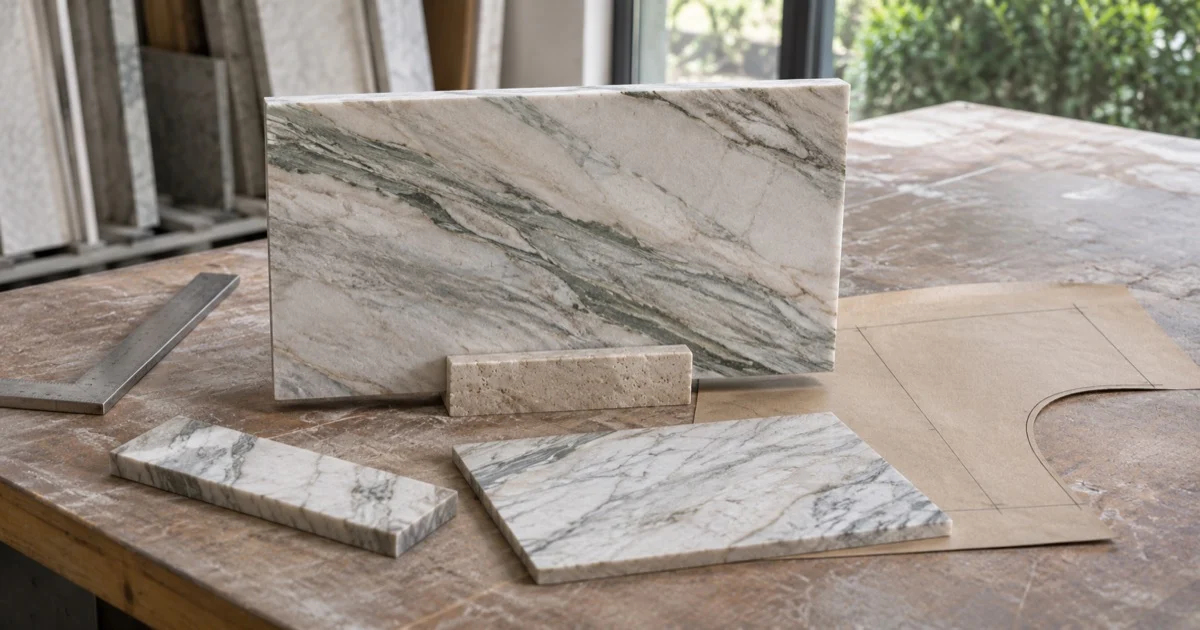
A stone slab layout maps your measured benchtop, splashback and other pieces onto the actual slab before fabrication. It balances usable material, pattern, joins and practical cutting constraints. Review the complete layout with your fabricator, because the smallest apparent waste does not always produce the best-looking or most workable result.
Planning offcuts starts before the main pieces are cut. Tell your fabricator about any smaller pieces you would like considered, while keeping the kitchen’s main requirements first.
What should a stone slab layout show?
The layout should show the pieces required, their orientation and their relationship to the actual stone. Confirm dimensions, openings, visible edges and any features you want to retain or avoid.
- Review vein or fragment direction across adjoining pieces.
- Identify benchtop, splashback and waterfall sections.
- Agree on joins and visible edge treatment.
- Check usable dimensions and areas requiring assessment.
Do not calculate a guaranteed number of slabs from total square metres alone. Piece shapes, fabrication allowances and material conditions affect what can be produced.
How do vein direction and joins affect the result?
Pattern direction can determine which parts of the slab are suitable for each piece. A continuous-looking arrangement may use material differently from a layout that prioritises smaller offcuts.
| Priority | Pattern control | Layout flexibility |
|---|---|---|
| Feature-led placement | Higher | Potentially lower |
| Flexible orientation | More variable | Potentially higher |
Review the actual proposal rather than expecting invisible joins. The Natural Stone Institute’s selection guide supports inspecting stone in the context of your project.
Which stone patterns should you inspect at full scale?
Compare Ceppo Rosso, Calacatta White and Fantasy Lux before choosing a layout direction. Ask how the actual slab’s prominent features would relate to your main work area and vertical panels.
 Marble collection
Ceppo Rosso
View the actual slab and confirm suitability.
View stone Marble collection
Calacatta White
View the actual slab and confirm suitability.
View stone Quartzite collection
Fantasy Lux
View the actual slab and confirm suitability.
View stoneInspect ESG’s stone slabs alongside the measured piece list. Confirm material classification, finish, current availability and usable dimensions before approving fabrication.
What can you realistically do with stone offcuts?
Discuss possible smaller pieces early, then let the fabricator assess the remaining usable material. An offcut still needs suitable dimensions, finish, fabrication and support for its proposed use.
Confirm who retains the offcuts and how handling, finishing or storage will be arranged. Do not assume every remnant can become a shelf or tabletop without further assessment.
Check Safe Work Australia’s engineered stone ban guidance when considering manufactured materials following the 1 July 2024 ban. Never cut, grind or drill offcuts yourself: small pieces can still release hazardous silica dust during processing.
What else should you ask about slab layout?
Can slab requirements be calculated from square metres alone?
No. Total area is only part of the calculation. Piece dimensions, orientation, joins, cut-outs, fabrication allowances and the actual usable slab all affect the result. Have the fabricator review a measured piece list and layout before confirming slab requirements, and avoid assuming a fixed waste percentage.
Are stone offcuts always useful?
Their usefulness depends on the remaining dimensions, condition, pattern and proposed application. A small piece still needs appropriate fabrication, edges and support, and some shapes may not suit the item you have in mind. Discuss possibilities before cutting and confirm the offcut ownership and handling arrangements.
Can you guarantee a continuous vein across every piece?
No general guarantee can replace reviewing the actual slab and proposed cuts. Natural variation, available dimensions, joins and the shape of each piece influence continuity. Ask your fabricator to show adjoining pieces and explain expected compromises before approving a pattern-led island, splashback or waterfall arrangement.
Can you cut an offcut at home for a shelf?
Never cut, grind, sand or drill a stone offcut yourself. Processing small pieces can still release hazardous respirable crystalline silica. Ask a professional to assess the material, dimensions, edges, fixings and support before deciding whether the remnant can safely become a shelf or another item.