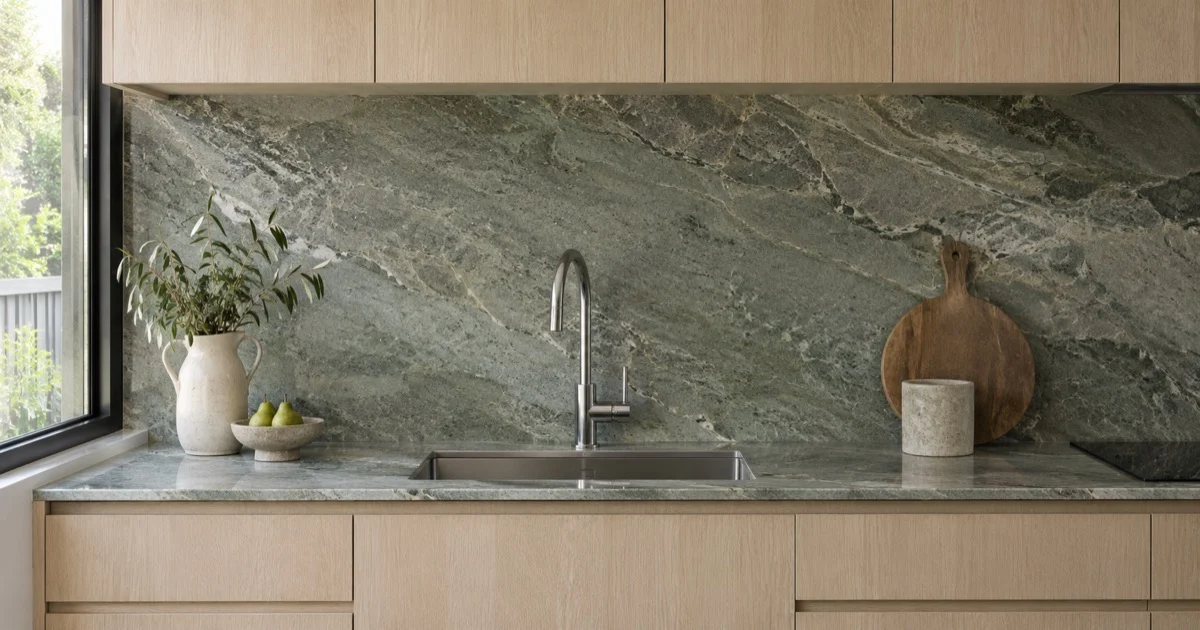
Stone splashback ideas work best when you coordinate the actual slab with your cabinetry, lighting and daily cleaning. Consider a red fragment pattern, grey veining, a quieter neutral, flowing movement or green colour. Confirm the material, finish, measured layout and appliance requirements before turning a visual idea into a specification.
A splashback is the wall surface behind a benchtop. These five directions use ESG catalogue examples to help you compare appearance; they are design suggestions, not performance rankings or promises of current stock.
Which stone splashback ideas suit your material palette?
Start with the role you want the stone to play, then compare these five natural directions. Keep surrounding finishes simple enough to see what each slab contributes.
1. Let Ceppo Rosso’s fragment pattern lead
Consider its reddish fragments beside quieter cabinetry or warm timber tones. Review the full slab before deciding which features belong behind the main work area.
2. Use Calacatta White for grey movement on white
Compare its grey veining with the cabinet colour under your intended lighting. A restrained surrounding palette can leave room for the stone’s movement without repeating another strong pattern.
3. Choose a quieter neutral with Bianca Perla
Consider Bianca Perla’s subtle marble pattern if you prefer lower visual contrast. Check the actual slab’s beige-grey tones beside paint, flooring and handles rather than matching separate online photographs.
4. Give flowing movement a clear area
View Fantasy Lux quartzite slabs when exploring a more fluid pattern. A broad wall area can show movement, but the final piece sizes and joins depend on the actual slab and site.
5. Introduce green through Aqua Green
Compare its natural green direction with timber or a quieter solid cabinet finish. Confirm the slab’s colour and mineral variation in person, since a product name cannot describe every piece.
 Marble collection
Ceppo Rosso
Inspect the actual slab and confirm its finish and suitability.
View stone Marble collection
Calacatta White
Inspect the actual slab and confirm its finish and suitability.
View stone Granite collection
Aqua Green
Inspect the actual slab and confirm its finish and suitability.
View stoneHow should you choose a stone splashback height?
Choose the height from the room’s layout and the area you want to protect. A lower return and a fuller wall treatment create different visual effects, with final dimensions confirmed on measure.
| Design approach | Visual presence | Coordination |
|---|---|---|
| Lower stone return | More restrained | Wall finish above still matters |
| Larger stone wall area | Stronger | More openings and layout review |
These are qualitative design comparisons, not fixed performance ratings. Check cabinetry, window sills, power points and the appliance manufacturer’s requirements with your project team.
Which practical checks belong in a kitchen splashback design?
Confirm the wall substrate, intended fixing system, openings and material suitability before approving fabrication. A striking slab still needs a workable installation detail.
- Have the fabricator review piece sizes, joins and edge positions.
- Coordinate cooktop and service requirements with the relevant trades.
- Ask how the finish will show cooking residue and everyday marks.
- Keep acids away from carbonate-rich stone where unsuitable.
Follow Natural Stone Institute care guidance and obtain instructions for the selected finish and treatment. Sealing does not prevent acid etching, a chemical change to the surface finish.
How do you approve the final stone splashback layout?
Approve the selected slab, finish, measured dimensions, openings and join positions together. Bring your cabinet and flooring samples to ESG so the visual choices and fabrication details can be discussed in the same review.
For manufactured alternatives, read Safe Work Australia’s engineered stone ban guidance. The ban on prohibited engineered stone benchtops, panels and slabs began on 1 July 2024; a brand name alone does not establish compliance.
Never cut, grind, sand or drill stone yourself, including power-point openings. Processing can release hazardous respirable crystalline silica, so leave fabrication, handling and installation to professionals.
What else should you know?
Must a stone splashback match the benchtop?
No. You can coordinate different stones or finishes if the colours, patterns and practical requirements work together. Compare actual samples under the intended lighting, then inspect the full slabs. Confirm each material’s suitability and care separately rather than assuming a visual match also means identical performance.
Can marble be considered behind a cooktop?
It can be considered, subject to the actual stone, finish, treatment and complete installation detail. Confirm appliance requirements, clearances and the fixing arrangement with the relevant professionals. Marble can react to acids, so also consider cooking residue, suitable cleaning products and your tolerance for surface changes.
Does a full-height splashback guarantee no joins?
No. Piece sizes, usable slab dimensions, wall conditions, openings and handling access all affect the layout. Review a proposed arrangement with your fabricator before approval. A larger wall treatment describes the design extent; it does not promise one-piece fabrication, invisible joins or continuous natural pattern.
Can you cut a power-point opening yourself?
Never cut, grind, sand or drill stone yourself, even for a small opening. Processing can release hazardous respirable crystalline silica and affect vulnerable sections of the stone. Have the fabricator coordinate openings with the relevant trade and carry out the work using appropriate professional controls.