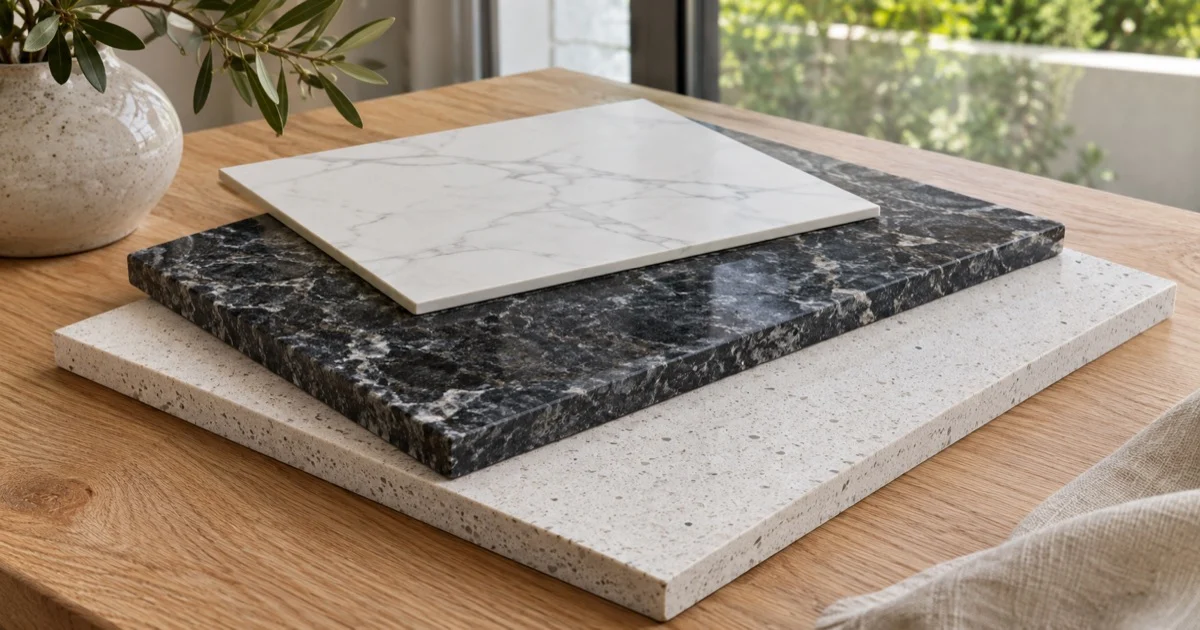
Engineered stone alternatives include natural marble, quartzite and granite, plus manufactured products that fall outside the prohibited definition or meet relevant exclusions. In Australia, choose the exact product rather than a brand name alone. Confirm composition, intended application, fabrication instructions and daily care before approving a replacement benchtop.
Australia banned prohibited engineered stone benchtops, panels and slabs from 1 July 2024. Your shortlist should begin with documented materials that can be supplied and installed for the proposed use.
Which engineered stone alternatives should you shortlist?
Start with your daily use and the finish you want. Marble offers natural variation with acid sensitivity, while genuine quartzite and many granites generally provide stronger resistance to ordinary food acids.
| Material family | Slab variation | Care review |
|---|---|---|
| Marble | High | Higher attention |
| Quartzite or granite | High | Stone dependent |
| Porcelain or sintered product | Product dependent | Manufacturer specific |
These are general comparisons, not ratings for a particular ESG slab. Confirm the actual material’s composition, treatment and intended use.
Which natural stone examples can you inspect?
Ceppo Rosso, Fantasy Lux and Aqua Green provide three different natural stone directions. View the actual slabs and discuss how their pattern and care requirements relate to your layout.
 Marble collection
Ceppo Rosso
View the actual slab and confirm suitability.
View stone Quartzite collection
Fantasy Lux
View the actual slab and confirm suitability.
View stone Granite collection
Aqua Green
View the actual slab and confirm suitability.
View stoneBrowse ESG’s stone slab collection before a showroom visit. Confirm current stock, usable dimensions and finish rather than assuming the pictured slab is reserved for your project.
How should you assess brands and manufactured options?
ESG supplies Caesarstone, Cosentino, YDL, WK Stone, Vicostone, Lavistone, Warner Stone and AC Stone. Cosentino ranges supplied include Dekton, Sensa and Xeron.
This list establishes supply relationships only. It does not confirm the composition, compliance, performance or warranty of any individual range; ask ESG for the exact current product and its documentation.
Safe Work Australia’s ban guidance explains the exclusions, including porcelain and sintered stone without resin. Do not infer that every product sold under one brand has the same classification.
What should you confirm before choosing an alternative?
Confirm the product code, composition and suitability, then review the complete installation and care requirements. Ask how edges, joins, cut-outs and supports will work in your particular kitchen.
- Compare representative samples under your lighting.
- Read cleaning and heat-protection instructions.
- Agree on final site measurements and access.
- Request written fabrication and installation details.
The Natural Stone Institute’s care guidance helps explain natural stone maintenance. Never cut, grind or drill a surface yourself; processing can release hazardous silica dust even where the material is a compliant alternative.
What else should you ask about engineered stone alternatives?
Which alternative needs the least maintenance?
There is no reliable answer based only on a broad material name. Compare the exact products’ cleaning, sealing, heat and impact instructions, alongside your own cooking habits. A surface that suits one household may not suit another, and low maintenance never means protection and care are unnecessary.
Does ESG supply the listed surface brands?
ESG has identified Caesarstone, Cosentino, YDL, WK Stone, Vicostone, Lavistone, Warner Stone and AC Stone as supplied brands. Ask for the current range and exact product code. That brand list does not establish individual product composition, availability, compliance, suitability or warranty terms.
Can natural stone replace an existing benchtop?
It may be possible, but the cabinetry, supports, openings, dimensions and access need assessment. Replacing an existing surface can affect sinks, appliances and surrounding finishes. Have the project team review the complete installation, and arrange professional assessment and controlled removal if the old surface is engineered stone.
Does a compliant surface eliminate silica dust risk?
No. Legal classification and processing safety are different issues. A compliant natural or manufactured surface may still contain crystalline silica and require appropriate professional controls during fabrication. Never cut, grind, sand or drill it yourself, and confirm safe handling and installation arrangements before the project starts.