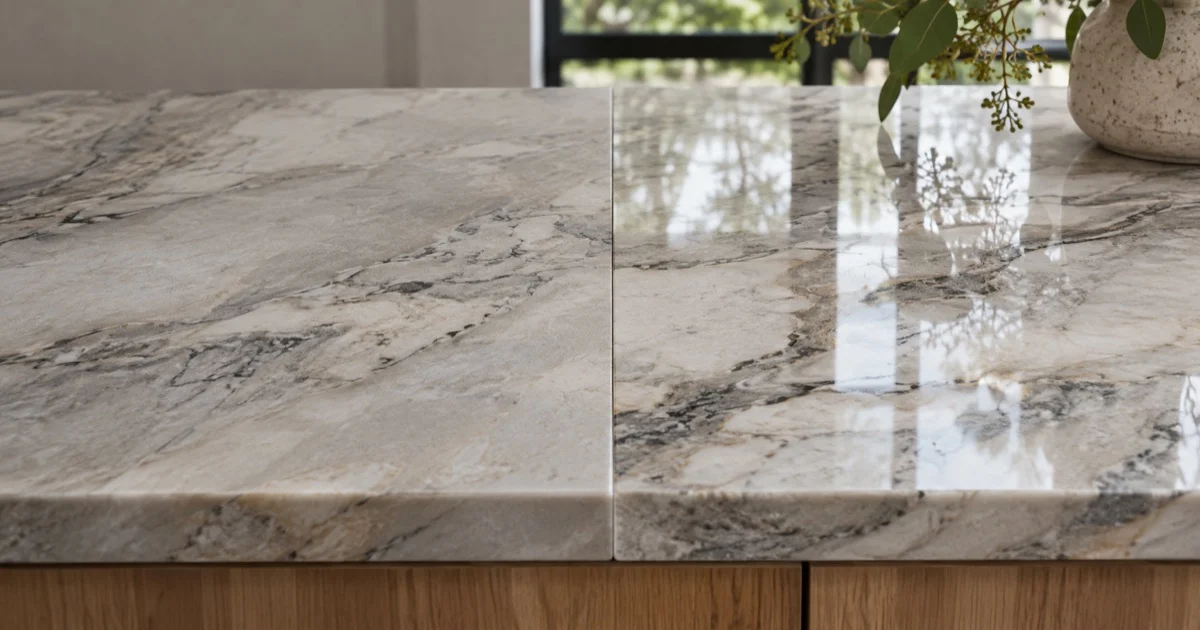
Natural stone myths often begin with assuming a category name guarantees performance. In reality, composition, finish, treatment and installation all matter. Sealer does not prevent acid etching, hard stone can chip, and natural patterns vary. Confirm the actual slab and its care requirements before relying on a broad buying claim.
These ten facts help you replace vague assurances with questions your supplier and fabricator can answer. They apply to selection and everyday use, not to home testing with acids or cutting tools.
Which natural stone myths confuse material identity?
Start by separating mineral names, geological rock types and commercial product labels. The Natural Stone Institute’s scientific and commercial definitions explain the distinction.
- Myth: every white veined stone is marble. Similar appearances can occur in different materials.
- Myth: quartzite and manufactured quartz are the same. Natural rock and manufactured surfaces have different origins.
- Myth: Super White is always quartzite. ESG’s supplied inventory lists it as dolomite; confirm the particular slab’s classification.
Do not perform acid, scratch or dust-producing identification tests on a benchtop. Ask for reliable material information and professional assessment.
Which stone care myths create unrealistic expectations?
Protection and care remain necessary even where a material is generally durable. Use Natural Stone Institute care guidance to understand the limits of cleaning and sealing.
- Myth: sealer prevents all marks. An impregnating sealer reduces absorption but does not stop acid etching.
- Myth: hard stone cannot chip. Impact, edges, openings and support still matter.
- Myth: heat resistance means no trivets. Protect the stone and any treatments from direct cookware contact.
| Buying evidence | Reliability for your slab |
|---|---|
| Exact material and care documentation | Higher |
| Broad damage-proof claims | Lower |
Which natural slab variation myths affect selection?
Review the actual stone and proposed fabrication layout before approving it. A sample, photograph or total area cannot resolve every project detail.
- Myth: a sample shows the complete pattern. Full slabs reveal scale and variation.
- Myth: all joins will be invisible. Review adjoining pieces and realistic expectations.
- Myth: square metres alone establish slab count. Piece shapes, orientation and usable dimensions affect the layout.
 Dolomite collection
Super White
View the actual slab and confirm suitability.
View stone Marble collection
Ceppo Rosso
View the actual slab and confirm suitability.
View stone Quartzite collection
Fantasy Lux
View the actual slab and confirm suitability.
View stoneCompare Super White, Ceppo Rosso and Fantasy Lux as different catalogue materials through ESG’s stone range. Confirm the exact classification, finish and intended use.
What is the most important fabrication myth to reject?
Reject the idea that natural stone is safe to process without controls. Natural material can still contain crystalline silica and produce harmful respirable dust when processed.
- Myth: natural stone is safe for DIY cutting. Never cut, grind, sand or drill it yourself; use a professional fabricator with appropriate controls.
Natural stone remains outside the prohibited engineered stone category, but that is a legal classification rather than a dust-safety guarantee. Read Safe Work Australia’s engineered stone ban guidance for the ban applying from 1 July 2024 and its scope.
What else should you ask about natural stone claims?
Can a product name prove geological composition?
No. Commercial stone names and categories can differ from geological classifications, and the same trade name may be used inconsistently. Ask for information about the actual slab and its appropriate care. Do not assume that appearance, colour or a familiar name establishes acid resistance or other performance.
How should you confirm Super White’s classification?
ESG’s supplied inventory lists Super White as dolomite. Ask for classification information about the actual slab, since that inventory label does not establish the geological composition of every product sold under the same trade name. Confirm the selected material, finish and care requirements before specification.
Is an invisible join a realistic guarantee?
Do not rely on that guarantee without reviewing the actual material and proposed adjoining pieces. Natural pattern, cut orientation, piece sizes and installation details affect visibility. Ask your fabricator to show the layout and explain the expected appearance before approving joins in a benchtop, splashback or waterfall end.
Can you test stone identity by scratching or cutting it?
Do not perform dust-producing tests, cut, grind or drill a slab or installed surface yourself. Acid and scratch tests can also damage a finish. Ask the supplier for reliable classification information or arrange professional assessment using appropriate methods and controls rather than experimenting on your benchtop.