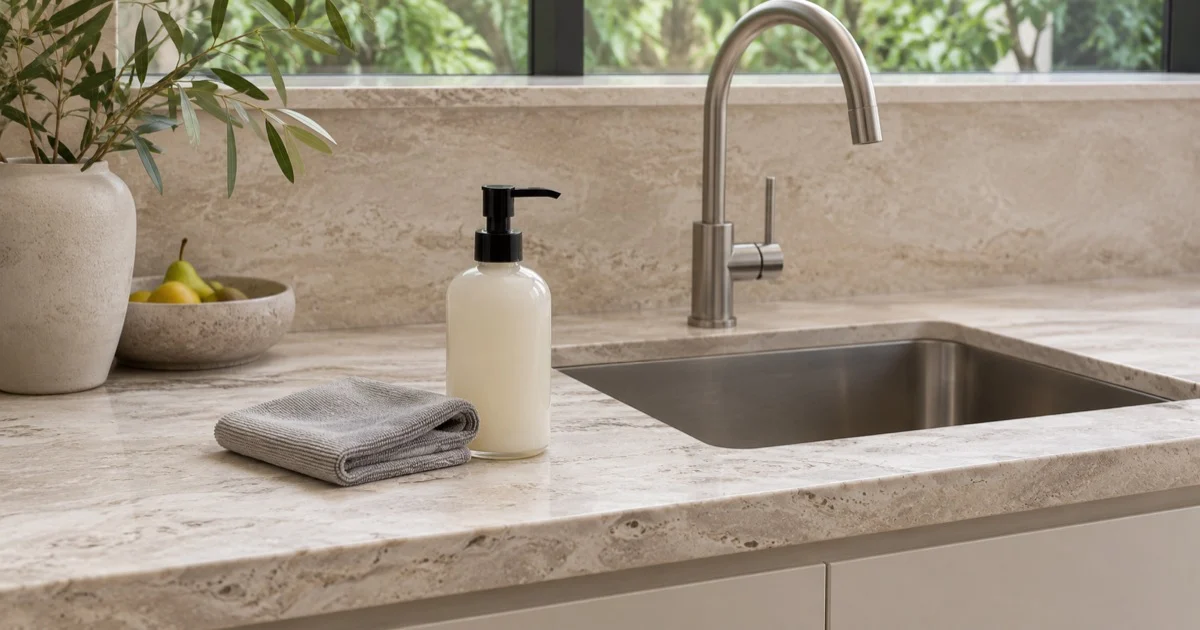
Choose a stone benchtop cleaner that is compatible with your exact material, finish and any applied treatment. A neutral cleaner is a useful starting point, but the full instructions still matter. Check acidity, abrasive ingredients, dilution and rinsing guidance before applying a product to the benchtop.
A stone benchtop cleaner labelled natural, kitchen or multipurpose still needs a compatibility check. This guide explains product selection without recommending unverified cleaner brands.
What should a stone benchtop cleaner label tell you?
Look for clear instructions relevant to the actual surface and task. If the label cannot resolve a compatibility question, contact the supplier or product manufacturer before use.
- Material compatibility. Confirm the stone type and intended finish.
- Acidity. Keep acids away from carbonate-rich stone.
- Abrasives. Avoid products that may scratch or dull the surface.
- Dilution. Follow the stated concentration rather than assuming stronger is better.
- Treatment compatibility. Check instructions for any sealer, filler or coating.
Use Natural Stone Institute care guidance for background on cleaner selection and the different responses of stone minerals.
Which cleaner claims need closer inspection?
Treat broad marketing claims as a prompt to read the full instructions. A product intended for one material or cleaning task may be unsuitable for another.
| Label information | Decision value | Next check |
|---|---|---|
| Exact material and treatment compatibility | Higher | Application instructions |
| General stone-safe wording | Limited | Specific exclusions |
| Natural or multipurpose wording | Low by itself | Full compatibility evidence |
No cleaner is endorsed here as stocked, tested or approved by ESG. Ask for a recommendation specific to your installation rather than inferring one from a general brand mention.
Why does cleaner compatibility differ between stones?
Marble and genuine quartzite do not respond identically to acids, and applied treatments add another consideration. Confirm the care instructions for Ceppo Rosso, Calacatta White or Fantasy Lux before choosing a product.
 Marble collection
Ceppo Rosso
View the actual slab and confirm suitability.
View stone Marble collection
Calacatta White
View the actual slab and confirm suitability.
View stone Quartzite collection
Fantasy Lux
View the actual slab and confirm suitability.
View stoneIdentify the material through ESG’s stone selection or your handover records. The catalogue name alone does not identify every treatment applied to your benchtop.
What should you avoid when a cleaner does not work?
Do not keep increasing concentration, mixing chemicals or scrubbing more aggressively. Residue, penetrating stains and acid etching are different problems and need different responses.
Photograph the mark and record the products already used before asking a stone specialist for advice. Never sand or grind the surface yourself; processing can release hazardous respirable crystalline silica.
If the surface is existing engineered stone, check Safe Work Australia’s engineered stone ban guidance before any proposed modification. Australia’s ban began on 1 July 2024 for prohibited new benchtops, panels and slabs, with limited controlled work on existing products addressed separately.
How do you choose a stone benchtop cleaner?
Does pH-neutral mean a cleaner is suitable for every stone?
Not automatically. Neutrality is useful information, but the complete formulation, task, finish and any sealer or coating still matter. Read the compatibility and application instructions for your exact surface, and ask the product manufacturer or stone supplier to resolve uncertainty before applying it to the benchtop.
Is a natural cleaning product safer for marble?
The word natural does not establish compatibility. Products containing vinegar, lemon or other acids can etch carbonate-rich stone even when marketed as natural household cleaners. Choose a product with appropriate material and treatment instructions, and avoid substituting a general cleaning recipe for stone-specific guidance.
Should you use more cleaner on a stubborn mark?
Increasing concentration can leave residue or create other problems without addressing the cause. Follow the product’s dilution instructions and have persistent marks identified. A dull etch patch, a penetrating stain and surface residue require different assessment, so seek advice before trying stronger chemicals or abrasive pads.
How should you check a cleaner recommendation?
Ask for a recommendation based on your actual material, finish, treatment and cleaning task. Check that the product’s instructions support that use, and resolve any uncertainty with the supplier or manufacturer. Keep the instructions with your installation records, and confirm compatibility before changing your cleaner or treatment.